

Quantum Simulation
Definition and key issues
There are problems that are so complex that they cannot be solved by a classical numerical simulation. For example, in condensed matter physics and computational chemistry, simulating a model Hamiltonian can require numerical resources and computation times that are too large to be performed with a classical computer. The main idea of quantum simulation is that it is possible to solve some of these problems by driving an experimental quantum system. Quantum simulation can also answer open questions from other disciplines, such as optimization problems or protein folding. Quantum simulation is distinct from quantum computing because it does not necessarily involve quantum information processing or the ability to manipulate each qubit separately.
The first quantum simulators already exist, but they have not yet been able to overcome the limits of classical simulations. The experimental obstacles to be overcome are the scaling capacity (in particular, to exceed the system sizes accessible to classical simulations), the control of the parameters of the model to be simulated and the suppression of extrinsic ingredients to this model, which becomes all the more problematic when the system size increases. An interesting perspective is the integration of a quantum simulator in a hybrid computing system. On the theoretical side, it is important to identify the open questions that can be answered by a quantum simulation, the observables accessible to the simulation, and the strengths of each simulator for a given purpose. Other issues that require theoretical work are the characterization of extrinsic ingredients that affect the performance of each simulator, as well as the comparative analysis of classical and quantum simulations.
Our strengths
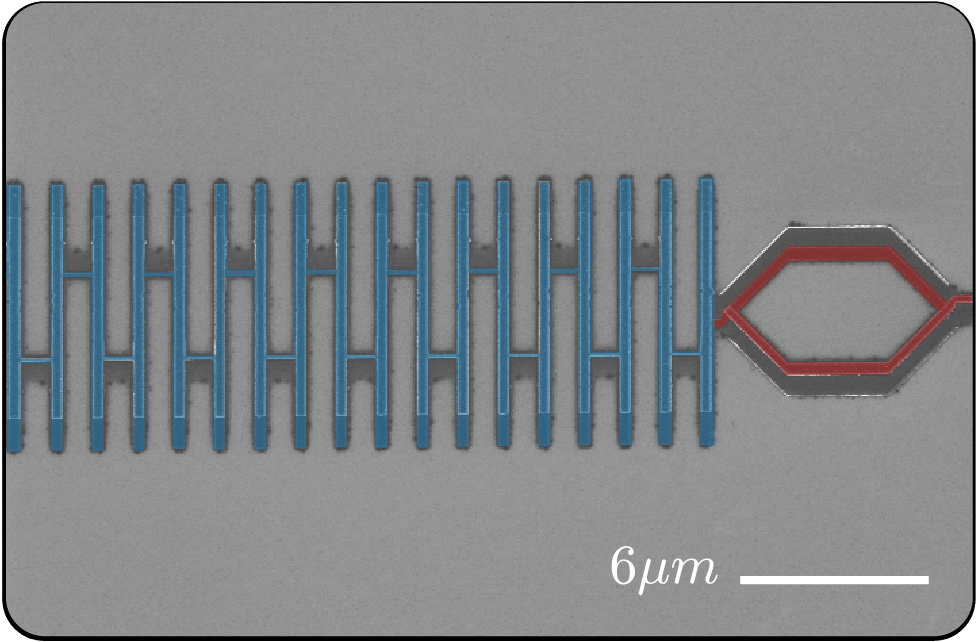
Grenoble hosts a great wealth of physical platforms for quantum simulation:
- magnetic insulators (SPINTEC),
- photonic nanostructures (Néel Institute, PHELIQS),
- electron and nuclear spins (LNCMI),
- spin qubits (Néel Institute, PHELIQS),
- two-dimensional materials (Néel Institute, PHELIQS),
- topological states in superconductors (PHELIQS),
- superconducting qubits and circuits (Néel Institute),
- opto-mechanical systems (Néel Institute).
Our goals
- Identify the most suitable experimental platforms to solve different classes of (theoretical) problems
- Strengthen the links between simulation platform hardware and simulation theory (theoretical physics, mathematics, computer science)
- Pushing the boundaries of classical simulation of quantum problems
- Establish standards for quantum simulation in noisy environments